Appointments
Stones, on camera, in daylight.
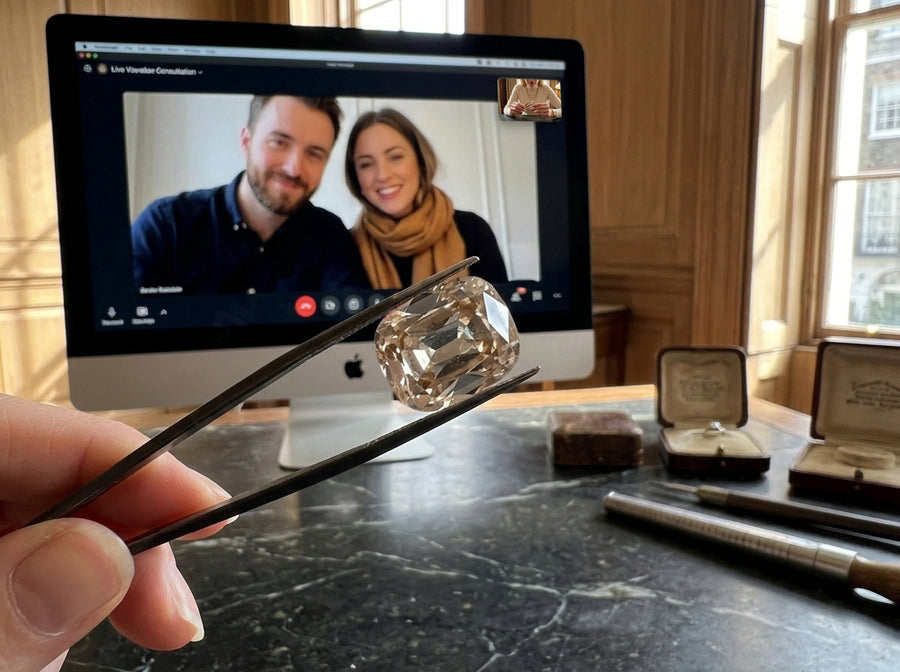
An old cut cannot be understood from a photograph. It has to be turned under light, and the difference between two stones of the same weight and grade only shows when they move. So we do that with you, live — Lucinda puts the stones she has selected for you under daylight and talks through what each one is doing. Most weeks of the year, from wherever you are.

Selected against one brief
What happens
Forty-five minutes, and something decided.

1
Before
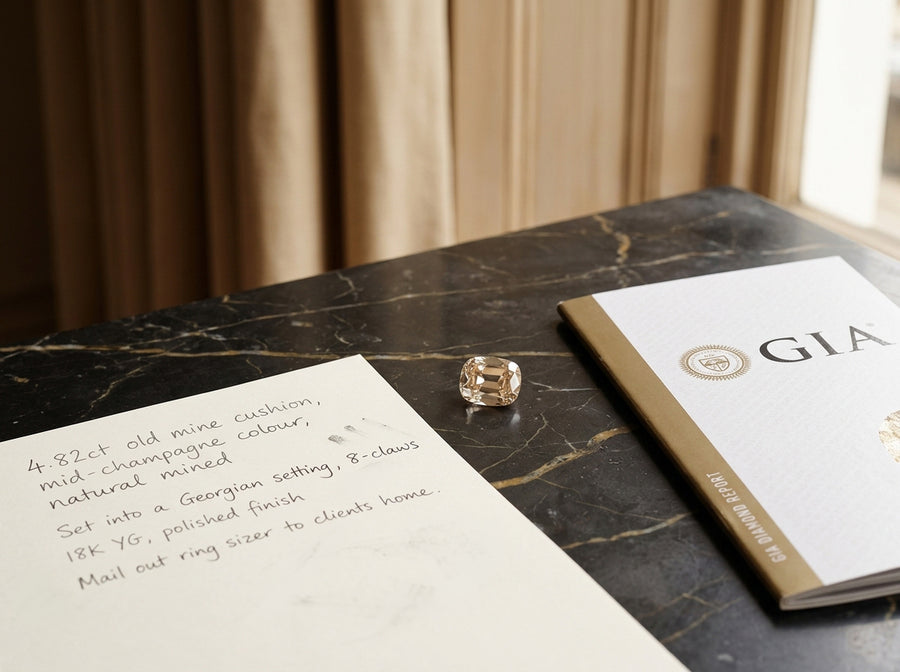
You tell us the shape, the rough size and what you are hoping to spend. If a setting has already caught your eye, say so — though you do not need to have one in mind. We source against that and hold a small number of stones and settings for the call, rather than showing you whatever is nearest to hand.
2
During
The stones are shown loose, in daylight, on camera. You will hear why one has better spread than another, and where the weight has gone in the ones that disappoint. We say when a stone is not worth its price. Settings are shown the same way — turned on camera, seen from the side, held against each other, so you can see how a profile changes what a stone does. If the setting matters more to you than the stone, the call goes that way instead.
3
After
You are sent images and film of anything you liked, along with the reports. Quoting and designs come next.
What you leave with.
Three things, and none of them require you to have decided anything: a shape you are drawn to, an approximate size, and a figure you do not want to go past. Any of them can be "not sure" — but the more of it we have beforehand, the more of the forty-five minutes is spent looking at stones rather than establishing what to look for.
Ring size is not needed at this stage and neither is a design. Settings come after the stone here, not before it.
If someone else is involved in the decision, bring them. It is a call — there is no reason for it to be one person.
The other way — private viewing
Two ways to see the work.
Different occasions, not different tiers. Most people who commission a ring only ever do one of them, and neither is a substitute for the other.
| A video appointment | Stones and settings, forty-five minutes, most weeks of the year. Diamonds shown loose under daylight and settings turned on camera. Hosted by Lucinda, with our designer where the piece calls for it. |
| A private viewing | Stones and settings, with the range physically in front of you. Profiles seen from the side, rings tried against each other and against your own hand. A few days a year, in one city. Hosted by Lucinda, with our designer where the piece calls for it. |
| Which first | Either. Some people begin with the stones and never see the range in person. Others see the range first and come back to the diamonds once they know which direction they are in. |
Or write
Tell us what to look for.
If nothing in the calendar suits, or you would rather not book before speaking to anyone, this reaches us directly and we will find a time.