22 April 2026
They don't sparkle. They glow.
A grading report describes a diamond completely and tells you almost nothing about it.

A modern brilliant is a solved problem. Fifty-seven facets, angles calculated to return the maximum light through the table, cut by machine to a tolerance measured in fractions of a degree. It works. Under a jeweller's lamp it is spectacular, and that is precisely the environment it was optimised for.
An old mine cut was solved by a person, by hand, two hundred years ago, for a room lit by candles.
The difference is not romance. It is geometry. Old cuts carry a smaller table, a higher crown, a deeper pavilion and a large open culet — proportions that were not chosen to maximise return under a spotlight, because no such thing existed. They were chosen to do something with the light in a room at night.
What they actually do
They don't sparkle. They're not loud. They glow.
That is the honest description, and it is the one thing a grading report has no way of recording. A report tells you colour, clarity, carat and cut grade. Every one of those is a measure of how closely a stone approaches an ideal. None of them describes character, because character is deviation from the ideal, and the language of grading has no word for it.
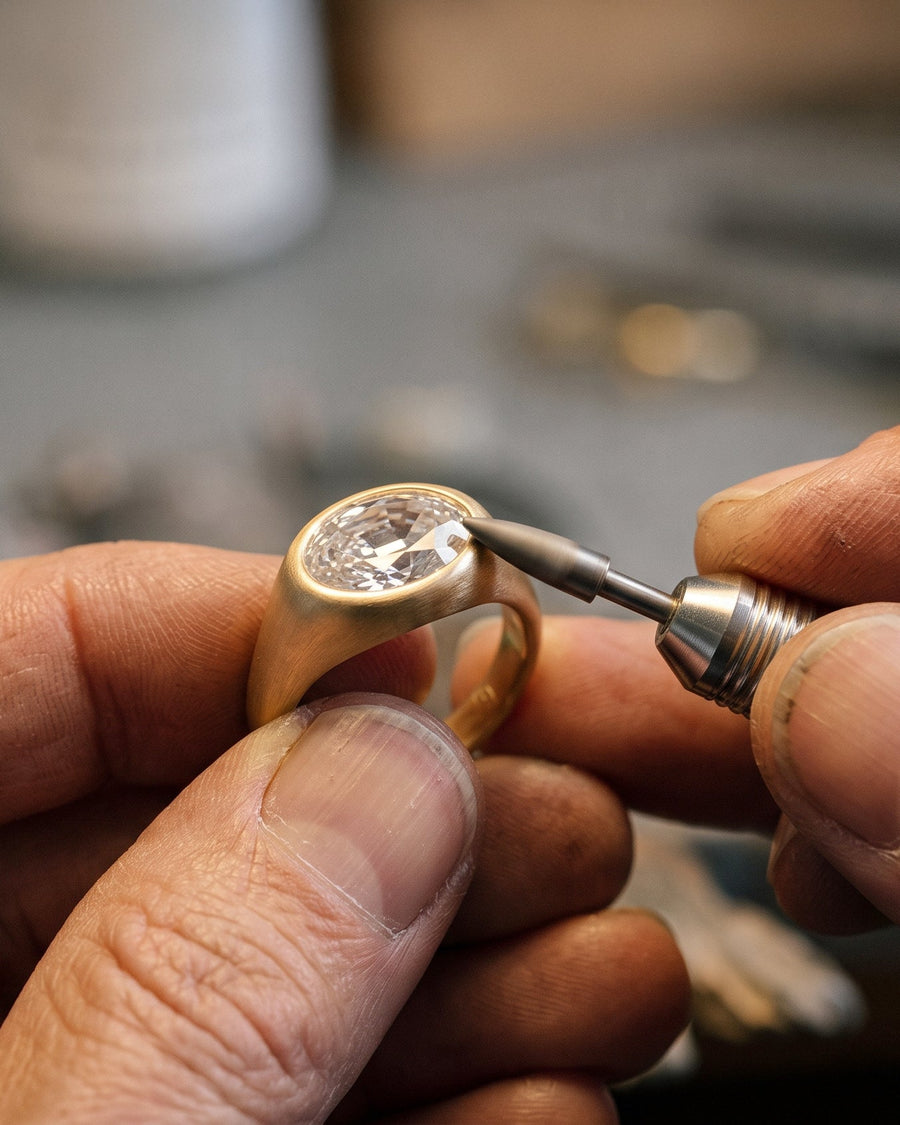
Cut by hand using traditional methods, every facet is not perfect. It is this that makes them beautiful.
Two facets meeting slightly off, a culet a fraction wide, a girdle that is not quite symmetrical — in a modern stone these would be faults. In an old cut they are the reason two diamonds of identical weight and grade sit differently on two different hands.
Which is why we choose the stone first
We select for face-up spread, for balance, for how it presents on a hand — not for the number on the report. A 2.00ct old mine cushion that reads small and dull is worth less to us than a 1.70ct that carries its weight across the face and holds light.
You cannot buy that from a list. It has to be looked at.
This is also why our rings are built around a chosen diamond rather than the other way round. A setting drawn for an ideal stone will fit an ideal stone. Very few of the ones worth having are ideal.
If you are choosing between an old cut and a modern one
Ask what you want the ring to do at dinner.
A modern brilliant is unmistakable across a room. It announces. An old cut asks to be looked at closely and rewards it — it is quieter at distance and considerably more interesting at arm's length.
Neither is better. But they are not substitutes, and being sold one as a version of the other is how people end up with a ring they never quite settle into.
MARLII LAB · London and Australia